
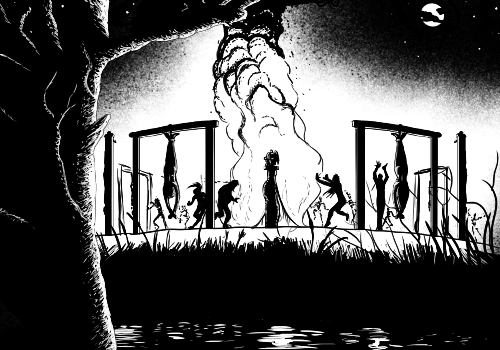
Torches blazed, and sacred chants were phrased
As they start to cry, hands held to the sky
In the night, the fires are burning bright
The ritual has begun, Satan’s work is done
-Iron Maiden
Number of the Beast
There is an old saying, with variants in many worlds and cultures, that to understand Chaos, one must lose oneself to it. That, of course, has never stopped curious folk from trying.
Nearly all the churches of the Thousand Gods of the Vold, and many lesser deifics striving for a place in the pantheon, have a simple stance on Chaos: It is the great destruction. The apocalyptic force shredding, twisting, and devouring the multiverse. It not only manifests in the great maelstrom of the Abyss and the Crisis Worlds, but it echoes out, distorting holy life and clawing its way into the soul and material of the multiverse. It warps life and lifeforce, creating aberrations and manifesting as demons. It rots the mind and the soul, spawning cults and the darkest of covens. It even corrupts the perfect language and rigorous forms of arcane magic, degrading it into something perverse but powerful. And all its strange radiation has one goal: the utter destruction of reality toward its own churning matrix.
Most people are ignorant of the existence of Chaos. Shepherding churches tend to refer to it, when they do, as corruption. They preach in uncertain terms and often with self-serving biases on the horrors of corruption. Many sermons thunderously warn that any twisting of nature’s forms is an aberration, and any manifestation of depraved desires is demonic. However, what they consider twisted or depraved is subject to divine interpretation, which, more often than not, comingles with church political goals.
Wizards, often more objective in their study of reality’s underpinnings, are either careful in their study of Chaos or overcome by it. In the current age, Cal’thal Academy of Voldipolis Prime bans the study of Demonology and Chaos, but in ages past, Bakob herself, later obtaining godhood, created the canonical arcane study of Chaos and its relationship with the Multiverse—the so-called Seven Disks. Among his theories on the nature of Chaos, Bakob presents three magic items and two alchemical tests for detecting Chaos in flesh and inanimate matter; many are used by the masters of Cal’thal and primarchs of various churches today.
In that work, Bakob proved that the radiation of Chaos pulsates into the Multiverse, corrupting the life and material of the Great Forge. But the preeminent mage pondered a strange conclusion—that all life, all Essence, may have been an emergent property of the contact of Chaos and the Multiverse.
This dangerous theory is considered heresy by most churches and (except that of Bakob herself, of course) prohibited by the Cal’thal and various lesser arcane fellowships. A translation of Seven Disks, complete with the offending chapters, is exceedingly rare. Only the scribe Belintal (obviously a pseudonym) dared to add it to his compilation of the Disks in the past millennium.

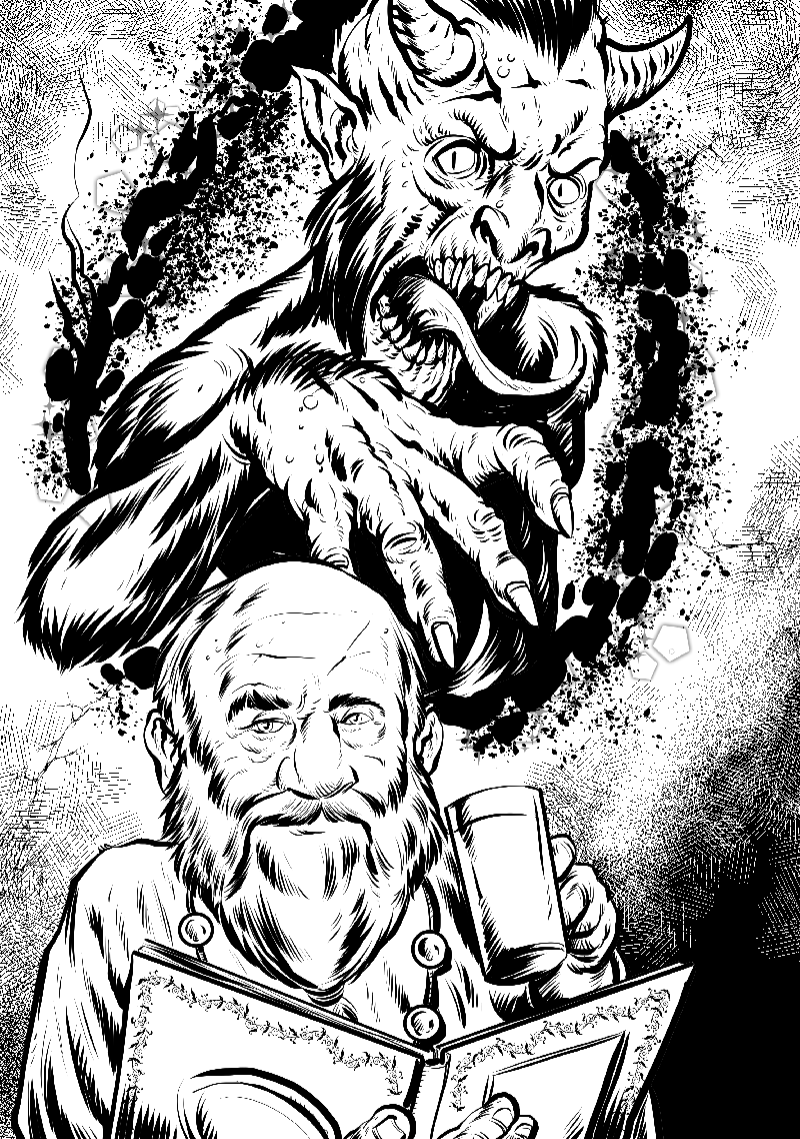
Belintal (or pseudo-Belintal—debate rages among learned circles) was also the arcane collaborator of Brother Savro Guin’s On Chaos, providing arcane explanations demon manifestation and insights into the heretical theories of the Seven Disks. This, of course, doomed Guin to purifying flames during the Photalus Inquisitions, but strangely, nearly 400 years after those purges, both this book and his companion, On Nature, once again grace the shelves of the curious and knowledgeable.
The most prized of these volumes also contains a handful of letters sent to Brother Guin from the purported Belintal. A passage from one of the more insightful missives is presented below.
“The best we can ascertain from first-hand accounts of Chaos rituals and rites—led by witches and other lesser arcane practitioners, sometimes no more than talented mountebanks—is that they create power through something that can only be called arcane malfunctions. These malfunctions are no more than mockeries of the signs and syllables of Dweomoric—that beautiful, perfect, and universal language of arcane power—that they often call Gulluth. These bastardizations of the proper forms coalesce into something I would call spell-like: carrying enough spark to create arcane effects, but something more akin to the fumbling of sorcerers or the witches leaching from their patrons.
“What makes this mockery and even greater danger is the way that the radiation of Chaos is attracted to such magical malfeasance. Lacking the fortification and discipline of true wizardly study, this entropy snakes into the unguarded crevasses of such artifice. While I hesitate to give the entities of Chaos anything close to real intellect, they do seem to have dangerous cunning. They can ape and use the tools of reason, but only for their own most absurd and destructive end. They can access creativity, reason, and the elementary roots of arcane magic through mortal intermediaries.

“We see some evidence of this in the forbidden practice of demonology by wizards. Such practitioners who call demons always call one of the nine stable types of demons: quasits, succubits, dezrits, szalits, tsrozous, plaugrezous, marlizous, balezous, and tyranzous. The careful practice of such rigor can bind the malignant clay of Chaos into these sometimes purposeful forms. Still, the summoning of lesser practitioners, or, if such stories are to be believed, the spontaneous emergence of demons at the fringes of the Abyss, creates a greater diversity of demonic forms.
Chaos cults, almost always led by a skilled and charismatic leader, usually of a melancholic bent, or a small cabal of bickering choleric, are already prone to self-proclaimed grandeur and personal imposture. Those ill temperaments manifest through the demons they summon and the aberrations they create. The power of these unique formation demons is tied to the leader’s power and the size of the cultist flock they can bind to the summoning and worship of Chaos.
“Thus, while all demons are the manifestations of Chaos, and all are dangerous, there are two main kinds of these horrors. Maybe three. There are the typed demons, fused into a specific shape and essence by the rigors of arcane magic, those called by other spellcasters and cultists that take the form and essence of the caller’s malignant aspects, and maybe those that generate randomly in the areas where the Abyss is subsuming the Multiverse.
“In truth, it is that third aspect that gives me pause. I hope it does not exist, and that manifestations called Chaos cults on Crisis worlds and planes are eager to appease Chaos before annihilation, somehow (and hopelessly). However, evidence brought back by foolhardy crisis Gate crashers leads me to believe this is hopeful thinking on my part. Maybe the Fallen Choirs of the Celestial Schism were right.”

Next time we will take a look at a cultist demon, some of Bakob’s items for dectecting Chaos, and a tool or two for fighting the manifestations of the Abyss.
On the Delve Patreon, there are already a couple of Monster Monday posts, detailing the first four types of arcanely called demons, and next Monster Monday, we’ll be taking a look at a spontaneously generated demon.
This will culminate in the details of the strange costal cult of Dagon, and the Sea Caves of Dagon-Tuth adventure site, all will be available for Delvers and higher in the coming weeks.


Leave a Reply